
Fiorino
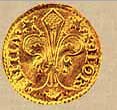
The Fiorino d’Oro:*
The Coin that Built the Renaissance
On 31 October 1252, the Republic of Florence struck a coin that would change the history of money. It weighed 3.537 grams of nearly pure gold, bore the lily of Florence on one side and Saint John the Baptist on the other, and was called the fiorino d’oro—“the little flower.” For the next three centuries it was the most trusted, most imitated, and most enduring currency in Europe. More than a piece of metal, the gold florin became the monetary foundation of the commercial revolution, the Italian Renaissance, and the first truly international European economy.
The Vacuum It Filled
By the middle of the thirteenth century, western Europe had almost no gold coinage. The Carolingian silver denier had been progressively debased for four hundred years; lords and kings clipped, sweated, and re-issued lighter coins until a penny barely contained any silver at all. Long-distance trade was forced to rely on cumbersome silver ingots, Byzantine hyperpyra that rarely reached the West, or Arab gold dinars that Christian merchants were reluctant to handle for both religious and political reasons. Merchants needed a coin that was large enough to settle substantial transactions, pure enough to be accepted anywhere, and stable enough to serve as a store of value. Florence, already a textile and banking center, had both the gold (coming via Tunis and the Champagne fairs) and the political will to create it.The new florin was deliberately conservative. Its weight was set at exactly one Florentine lira of account (20 soldi), and its fineness was an astonishing 24 carats at first, later stabilized at 23½. Unlike almost every other medieval ruler, the Florentine republic resisted the temptation to debase. From 1252 until the fall of the republic in 1533—a span of 281 years—the weight and purity of the gold florin hardly wavered. This extraordinary stability was the secret of its success.
A Currency for Merchants, Not Kings
The florin was not designed to pay soldiers or collect taxes; it was created for the international wool trade and for banking. Florentine merchants in Bruges, London, and Avignon needed a coin that would be accepted at face value from the Baltic to the Levant. By the early fourteenth century the florin had achieved exactly that. Contracts in England, Flanders, and the Hanseatic League were often denominated in “florins of Florence,” even when actual florins were unavailable. Papal collectors demanded payment in florins; Venetian galleys insured their cargoes in florins; the counts of Flanders fixed their taxes in florins.Its dominance forced competitors to imitate it. In 1284 Venice introduced the gold ducat (later zecchino), deliberately struck to the same weight and fineness so it could circulate interchangeably with the florin. Hungary followed in 1325 with the forint, the Rhineland cities with the Rhenish gulden, England with the noble (1360s), and eventually almost every commercially active state produced its own version. The very word “florin” became generic: the Dutch guilder, the German Gulden, and even the English two-shilling piece of the nineteenth century all trace their names to the little Tuscan coin.
Symbol of Florentine Power
The florin was propaganda as much as money. The unchanging design—lily and Saint John—broadcast the message that Florence, alone among Italian cities, had the civic virtue and technical mastery to maintain a pure coin for generations. When other cities debased their silver grossi in the 1340s, Florentine bankers could point to the untouched florin as proof of their city’s reliability. The Medici, who began as bankers exchanging florins in Bruges and Geneva, eventually placed their own palle (balls) on later issues, but even they dared not alter the weight that had become sacred.
The Slow Eclipse
The florin’s long reign ended not because it failed, but because the world outgrew it. The discovery of American silver after 1492 flooded Europe with cheap bullion, making large silver coins (testoons, thalers, dollars) more practical for everyday use. New gold strikes in Hungary and Africa, combined with improved minting technology, allowed larger gold coins like the Portuguese cruzado and the Spanish excelente. By the mid-sixteenth century the Venetian ducat had overtaken the florin as the preferred Mediterranean trade coin, partly because Venice controlled more of the eastern trade routes.Yet the florin did not vanish quietly. The Grand Duchy of Tuscany continued to mint gold coins called fiorini into the eighteenth century, and in 1859, during the brief independence before Italian unification, Tuscany issued a final gold “fiorino” of 100 quattrini—an affectionate nod to the coin that had once been the standard of Europe.
Legacy
The gold florin was the first modern currency in the sense that its value derived not from royal proclamation but from consistent quality and widespread merchant acceptance. It demonstrated that a city-republic could outperform feudal monarchies in monetary policy, and it financed the palaces, paintings, and libraries of the Renaissance. When historians speak of Florence as the “Athens of the Middle Ages,” they are also speaking of the little gold coin stamped with a lily that made it all possible. For almost three hundred years the fiorino d’oro was quite simply the most respected piece of money in the world—an achievement no currency before or since has quite equaled.
*AI generated